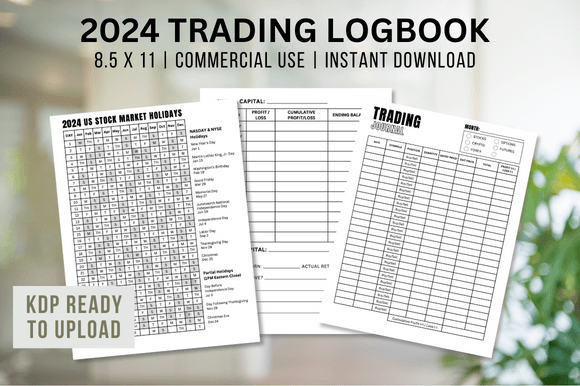
2024 Trading Logbook: Document Every Move in the Market
A single missed detail can reshape your understanding of a trade. The 2024 Trading Logbook is a ready-to-upload KDP interior designed to capture exactly that detail—entry price, exit strategy, emotional state, and more—so you stop guessing and start measuring. Created for anyone who needs structure in their trading day, this logbook skips the fluff and focuses on the fields that matter. It even bakes in the official 2024 US Market Trading Holidays, so you never plan around a closed exchange by mistake. Whether you are placing your very first options trade or refining a multi-leg strategy, having a consistent paper trail often separates fleeting luck from lasting progress.
Why Different Traders Need a Purpose-Built Logbook
Not all trading journals serve the same purpose. A spiral notebook might hold random notes, but it rarely forces the discipline required to spot patterns. The 2024 Trading Logbook provides a repeatable template that suits varied goals. A market newcomer might prioritize learning to record dates and symbols correctly. A swing trader might rely on the notes section to sketch catalysts like earnings reports or sector rotation. An options seller could track implied volatility rank, while a day trader may focus on execution speed comments. The common thread is that everyone benefits from seeing their history laid out identically, week after week.
For traders juggling a 9-to-5 job, the logbook also respects limited time. Filling out a page takes minutes but builds a reference library that can save hours of second-guessing later. The inclusion of US market holidays removes the friction of cross-referencing a separate calendar. Small efficiencies like this help you stay consistent, which is exactly what builds the habit.
A KDP Interior Ready for Self-Publishers and Creators
Beyond personal use, the 2024 Trading Logbook arrives as a clean KDP-ready file. This opens a door for content creators, coaches, and trading educators who want to offer their audience a branded tool without designing from scratch. Instead of spending weeks formatting margins and testing print alignment, you can upload the interior directly to Kindle Direct Publishing, pair it with your own cover, and deliver value under your own name. Bloggers writing about trading psychology can use the logbook as a lead magnet or a print-on-demand product. Coaches running group programs can supply it as part of a mentoring package, ensuring students work from a unified system.
Quality remains central here. The interior is laid out with clear typography and logical spacing so nothing gets lost in the gutter. Pages are organized to minimize decision fatigue: pre-set columns for trade data, a dedicated area for risk metrics, and subtle prompts that encourage review. The result looks professional, whether printed on standard paper or handed out during a workshop.
Beginners Who Want to Shorten the Learning Curve
Early trading often feels chaotic. You watch videos, scroll news feeds, and jump into positions based on fleeting confidence. The 2024 Trading Logbook introduces structure immediately. Instead of worrying about what to record, a newcomer follows the guided layout: setup, size, entry, initial stop, target, and actual outcome. Over 20 or 30 filled pages, a beginner can finally notice patterns—maybe they struggle to hold winners or consistently ignore a stop on Thursdays. Those insights rarely surface from memory alone.
Beginners also benefit from the built-in holiday list. There is no embarrassment in planning a trade around Memorial Day only to discover the market is closed. The ready-made calendar helps build awareness of market rhythms early, which is a subtle but real advantage.
Experienced Traders Who Need a Performance Audit
Advanced traders often keep multiple strategies running simultaneously. A scalper might flip shares in minutes while holding a swing position for days. Without a unified record, it becomes hard to compare returns across strategies. The logbook’s repeatable format allows a side-by-side review, helping you answer questions like “Did my mean-reversion setups perform better in high-volatility months?” or “What was my average win rate on earnings plays?” These are not vanity metrics; they inform position sizing and confidence levels.
Experienced users also appreciate that the logbook refrains from overengineering. Too many apps introduce friction through complex tagging and pop-up ads. A simple, offline paper journal stays fast, private, and immune to software updates. Some even use it as a hard backup to their digital spreadsheets, a practice that builds resilience in case of data loss.
Educators, Coaches, and Trading Groups
A shared logbook brings uniformity to education. If you teach a trader development program, giving every student the same 2024 Trading Logbook means you can reference exact page sections during feedback sessions. You can ask, “Check the pre-trade checklist on the left—what did you write for market context?” rather than decoding scattered notes. This saves time and makes coaching more concrete.
Small trading firms or investment clubs can use the KDP-ready file to create branded hard copies for members. The interior can be paired with a group cover design and printed on demand. Because it is a downloadable template, updates (like adding a risk-reward column) remain possible without reordering inventory.
Content Creators and Bloggers Looking for an Easy Product
Many creators in the finance niche want to sell a physical item without holding stock. The 2024 Trading Logbook KDP interior turns that wish into reality. Upload the PDF, set a price, and let Amazon handle printing and shipping. This approach works for bloggers who review trading platforms, podcasters who share mindset tips, and YouTubers who analyze chart patterns. Each can tailor the cover to match their visual brand, turning the logbook into a natural extension of their content ecosystem. It also provides a tangible product for affiliate promotions or holiday giveaways without high upfront cost.
Inside the Pages: What Makes a Trading Record Actually Useful
The gap between a mediocre journal and the 2024 Trading Logbook lies in the details. Each entry area encourages specific thinking. The date and instrument block keeps sequencing clean. The strategy tag prevents hindsight from rewriting the original plan. A trade management section tracks partial exits and stop adjustments, which is critical for evaluating discipline. After the close, a results box captures profit/loss in percentage and absolute terms, while an emotional rating scale asks you to face the mindset behind the numbers. Data without context is easy to ignore; context without data is just storytelling.
Because the layout is repeated, scanning multiple weeks reveals drift. You might see that your best trades share a common time-of-day window, or that poor sleep correlates with impulsive adjustments. These discoveries often happen only when the record makes them impossible to miss.
Practical Example: Putting the Logbook to Work
Imagine a part-time trader named Alex. Alex works in IT and trades futures during the first two hours after the open. Before using the logbook, Alex jotted notes in a phone memo app. The notes were messy and missing key details like slippage and pre-market sentiment. After switching to the 2024 Trading Logbook, Alex follows a before-and-after routine: jot the trade plan in the morning, then fill the actual results after the close. Within a month, Alex sees that winning trades nearly always involve a clear news catalyst noted beforehand. Losing trades, on the other hand, happen more often when the “market context” box is left blank. Simply keeping the logbook honest improved trade selection without changing the strategy itself. That small nudge converted a casual routine into a deliberate review process.
How Different Priorities Shape the Choice
When evaluating a trading journal, people weigh different factors. A hobbyist might care most about ease of use: can they jot a quick entry without fighting small fields? The logbook uses a clean, spacious design that favors a relaxed writing experience. A professional trader might prioritize reliability and long-term usefulness: will this record hold up during tax preparation or a performance audit? With clear sections and no reliance on third-party servers, a filled logbook serves as a durable physical asset.
A content creator evaluating KDP interiors likely focuses on presentation and commercial value. Is the layout polished enough to represent their brand? Are the margins and bleeds correct for Amazon's printing? The logbook arrives formatted to those exact specifications. An educator might value learning value and flexibility: can they customize the experience by accompanying the logbook with video lessons? Absolutely—the printed pages become a workbook companion. Meanwhile, a small business owner might consider cost. Because the interior is ready-to-upload, there is no design fee, and print-on-demand means zero inventory risk.
Matching the 2024 Trading Logbook to Your Goals
This product clicks best when you are ready to treat your trading like a craft that improves with honest reflection. If you need a plug-and-play solution to start tracking right now, the printable format gets you up and running today. If you are uncomfortable with purely digital records or want a backup system, a physical book adds peace of mind. If you plan to publish a branded journal for an audience, the KDP compatibility removes the most painful part of product creation—interior design.
Consider the alternative: building your own logbook from scratch. You would spend hours aligning columns, testing print alignment, and researching US market holiday dates. That time has already been invested in this interior. You can instead spend it on analyzing charts, refining your edge, or creating content around the product.
The logbook does not promise overnight riches; no piece of paper can. But it does promise a structure that makes progress measurable. That structure benefits the 23-year-old retail trader who is curious about their emotional patterns just as much as the 45-year-old coach who needs a reliable teaching aid. It supports the blogger aiming to monetize a website and the swing trader who simply wants to see if holding over a long weekend truly hurts their stats.
With the 2024 US Market Trading Holidays already built into the calendar section, you also gain a planning tool that aligns your trade awareness with the rhythm of the exchanges. That detail alone saves research time every month and keeps you in sync with official closings. Whether you use the logbook as your sole performance tracker or as a supplement to a digital dashboard, the clarity it offers remains the same: every trade gets its moment of scrutiny, and no pattern stays hidden forever.