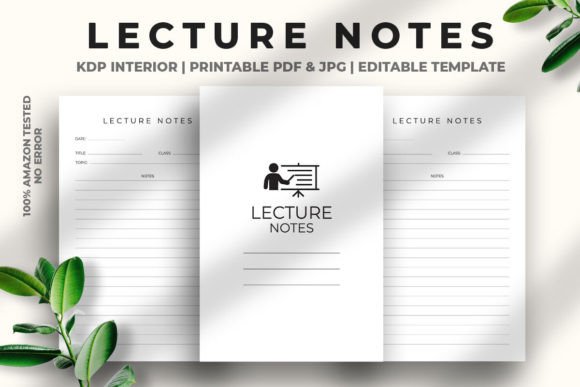
How Lecture Notes KDP Interior Templates Help Creators Move Beyond One‑Off Notebooks
Interior templates designed for Amazon Kindle Direct Publishing aren’t a new category. What is changing is how fast creators expect to move from a file on a hard drive to a product page that generates consistent royalties. When someone looks at a listing for a Lecture Notes KDP Interior, the first instinct is often to scan dimensions, page counts, and file formats. Spend a few more minutes with what serious publishers are actually doing, and a different picture emerges. The interior file becomes a growth lever, not just a formatted PDF sitting in a folder.
The Evolving Role of Interior Templates in Low‑Content Publishing
Three years ago, most KDP conversations centered on cover design. A catchy cover could lift a notebook or journal out of near-invisible rankings. Cover design still matters, but the market has matured. Buyers now read reviews that mention bleed issues, misaligned margins, and pages that drift too close to the binding. In that sense, the interior file has quietly become a risk‑management asset. A properly constructed Lecture Notes KDP Interior removes the single biggest cause of returns and negative feedback for educational stationery products: print‑ready inconsistency.
This shift parallels what happened in premium stationery long before print‑on‑demand existed. Moleskine and Leuchtturm didn’t win on covers alone. They won on paper weight, ruling, and the invisible grid that made handwriting feel organized. For KDP publishers, the same principle now applies digitally. Buyers expect an interior that behaves professionally when it’s actually bound and shipped.
Why a Lecture Notes Format Specifically Deserves Attention
Lecture notes occupy a useful middle ground between wide‑ruled notebooks and highly structured planners. There is enough guidance to keep a student or professional organized, but not so much structure that it becomes a rigid system they abandon after two weeks. That flexibility has pushed lecture‑note interiors into consistent year‑round demand, distinct from academic calendars that spike in August and September.
From a publisher’s perspective, the topic also opens up multiple positioning angles. The same Lecture Notes KDP Interior can be presented as a college note‑taking companion, a conference journal, a self‑study tracker for online courses, or a meeting log for professionals who take continuing education seriously. The keyword clustering potential is broader than what you get with a generic blank journal, yet the interior complexity remains manageable. You are not designing a 365‑day dated planner; you are offering a versatile template that adapts to several search intents.
Vector Editing and the Quiet Advantage of Scalable Workflows
Many low‑content interiors arrive as flattened PNGs or fixed‑size PDFs that break the moment a publisher wants to adjust spine margins or tweak the ruling width for a different trim size. The specific mention of vector support in an Adobe‑Illustrator‑compatible Lecture Notes KDP Interior changes the math. Vector files scale without introducing artifacts. That means a single interior can be adapted from 6×9 to 7×10 or 8.5×11 without rebuilding the grid, re‑aligning headers, or worrying about fuzzy lines on a proof copy.
Practical example: a creator running five KDP accounts across different niches can start with one well‑built 6×9 lecture notes template and produce versions for medical students, law students, and engineers simply by adjusting the header text and cover art. The vector core remains identical. This reduces time‑to‑market for new variations from days to hours. When a competitor tries to flood a sub‑niche with manual interior rebuilds, the publisher working with a truly editable PDF moves faster and spends less.
100 Tested on Amazon KDP – What Reliability Means in Practice
KDP’s automated print checks catch obvious errors, but they don’t simulate binding, consumer handling, or how a book looks after four weeks on a desk. The phrase “100 tested on Amazon KDP no error” signals something valuable: the file has survived multiple upload‑download‑proof‑print cycles without triggering trim warnings, margin rejections, or the dreaded white‑page gap some templates create when the live preview doesn’t match the source file.
Anyone who has uploaded twenty interiors in one sitting knows what that error loop feels like. You upload, wait for processing, get a cryptic margin alert, shift content by four pixels, re‑upload, and waste an afternoon. A Lecture Notes KDP Interior that has passed one hundred upload tests eliminates that friction. The number isn’t just marketing; it represents a file that has been through enough platform iterations to handle the quirks KDP occasionally introduces during processing. For a publisher targeting volume, those saved hours compound quickly.
6×9, No Bleed, and the Economics of Print‑Ready Efficiency
The 6×9 inch trim size has settled into the default for most KDP note‑taking products because it mirrors trade paperback proportions and fits comfortably on standard bookstore shelves alongside mass‑market competition. Choosing no‑bleed formatting means the interior doesn’t need color‑to‑edge printing, which expands printer compatibility and reduces per‑unit cost on Amazon’s fulfillment side. Those savings flow through to the creator’s royalty calculation, especially on Expanded Distribution orders.
For a 120‑page Lecture Notes KDP Interior, the no‑bleed approach also simplifies cover design. Cover creators don’t need to account for three millimeters of wrap that could shift during production. The predictability lowers the skill barrier for new designers entering the market, while giving experienced publishers one fewer variable to troubleshoot when a proof copy arrives slightly different from the preview.
Rethinking the “Low‑Content” Label
There is a tendency to group anything without full‑length prose under the “low‑content” umbrella and assume effort scales accordingly. Experience suggests the opposite. Buyers of lecture note notebooks are often mid‑to‑high‑intent purchasers. They plan to fill 120 pages with handwritten information that matters to their exams, certifications, or career development. If the interior feels flimsy, the ruling is too dark or too light, or the page numbers break awkwardly across sections, they notice.
The Lecture Notes KDP Interior template solves a particular tension here: it provides enough structure to feel designed, yet stays generic enough that the same file works for biology lectures, coding bootcamp notes, or a manager’s leadership seminar notebook. That balance is harder to achieve than it looks. Many interiors over‑design with icons, section dividers, and artistic elements that pigeonhole the product into one aesthetic. High‑quality vector lecture notes tend toward minimalism that lets the cover set the brand while the interior does the quiet work of being functional page after page.
Meeting the Expectations of a Maturing Amazon Marketplace
Amazon customers have grown more discerning as KDP catalogues expand. Five stars require more than a pretty cover now. Reviews increasingly mention paper quality feel, line spacing comfort, and whether the book lies flat enough for left‑handed writers. While a KDP publisher can’t control the paper stock Amazon selects, they can control whether the line spacing and ruling weight are optimized for visibility without overpowering handwriting. A 300 DPI Lecture Notes KDP Interior printed on even average paper renders cleaner lines than a 150 DPI equivalent, and that subtle difference drives higher satisfaction ratings over dozens of reviews.
Additionally, the “print ready” designation of these tested interiors signals that the file accounts for KDP’s gutter margin requirements. For 120‑page books, the spine width changes as page count increases, and the gutter margin needs to compensate so text and lines don’t vanish into the binding. New publishers often learn this through painful returns. Templates flagged as KDP‑tested bypass that lesson entirely.
Who Benefits Most, and Why It Isn’t Only Beginners
The initial assumption might be that ready‑to‑upload interiors serve mainly newcomers. That’s partially true; they eliminate the design learning curve. But experienced publishers with fifteen or twenty live titles often gain more value from a Lecture Notes KDP Interior that’s already vector‑editable. They aren’t starting from zero. They are expanding a catalogue, testing new niches, or refreshing older listings that need a design update without a full rebuild. The ability to open one file in Adobe Illustrator, change a header or adjust ruling in minutes, and re‑upload under a new ASIN means they operate more like a brand portfolio manager than a single‑product creator.
This shift is visible across the broader print‑on‑demand community. Where creators once celebrated a single notebook hitting bestseller status, serious operators now talk about systems. Interiors that are vector, tested, and immediately printable become building blocks. A lecture notes template sits on the hard drive alongside a log book interior, a recipe journal, and a habit tracker, each ready to spawn a dozen variants with minimal additional cost.
Common Misconceptions About Commercial‑Use Interiors
High resolution means large file size that slows uploads. A properly constructed 300 DPI PDF should still be well under the KDP upload limit. Resolution and compression aren’t the same thing. The Lecture Notes KDP Interior assets that truly slow things down are the ones that embed unoptimized fonts or convert every line into a rasterized layer.
Editable PDFs break when opened. They break when opened in programs that don’t support the editing features promised. When a template is explicitly labeled as Adobe Illustrator compatible, the expectation is that core structural layers remain accessible. Outside of Illustrator, the file may still open as a flat PDF for reference or printing, preserving the basic use case.
One interior fits all formats. A 6×9 no‑bleed interior won’t cleanly translate to a 8.5×11 bleed‑required coloring book without rework. Understanding where the template ends and customization begins saves disappointment. The vector nature helps, but the layout structure was tested at specific dimensions; straying far requires some manual adjustment even when scaling support exists.
Integrating Lecture Notes Interiors Into a Broader Content Strategy
Successful low‑content publishing in 2025 looks less like a guessing game and more like coordinated product launches. A creator might release a series of three notebooks in the same week: a Lecture Notes KDP Interior targeting STEM students, a lined journal for reflective writing, and a dot‑grid notebook for bullet journalers. The common thread isn’t the interior style but the cover branding, colour palette, and keyword synergy that lets one product description link naturally to another through Amazon’s “Customers also bought” engine.
The lecture notes interior fits attractively into this strategy because it covers a purchase intent that the other two formats don’t fully address. Bullet journals are intentional but unstructured. Lined journals are too plain. Lecture note interiors promise just enough framework to feel productive without overwhelming the user with prompts.
Observation From Ten Years of Print and Digital Design
Teams that have spent a decade in high‑end branding and product development understand something that casual template sellers sometimes miss: consistency across hundreds of printed copies matters more than a single stunning mockup. A Lecture Notes KDP Interior designed with global creative standards considers how the page looks filled, not just empty. The ruling weight, the contrast, the placement of page numbers, and the breathing room at the top and bottom of each sheet all contribute to the end‑user’s handwriting experience. Those details separate products that earn repeat purchases from those that get bought once and abandoned.
That depth of experience also explains why certain templates include high‑resolution JPG previews alongside the print‑ready PDF. Sellers need compelling product images for their Amazon listings. Providing 300 DPI JPG assets reduces the friction between downloading the interior and publishing the final listing. It’s a small inclusion that reflects an understanding of the full KDP workflow from design desktop to customer doorstep.
The Next Step for Publishers Thinking in Systems
Interior templates are not magic. A bad cover, ignored keyword research, and sparse customer review strategies will still undermine a listing regardless of how polished the inside is. But when everything else around the listing is solid, the interior becomes the foundation that holds up a catalogue. Vector‑editable, KDP‑tested assets let publishers focus their creative energy on market positioning and branding rather than troubleshooting file errors at midnight before a launch.
For anyone working to build a publishing business that grows beyond a handful of experimental titles, the choice isn’t between free interiors and paid ones. It’s between interiors that have been stress‑tested against platform requirements and interiors that might pass the upload preview but fail a discerning buyer’s expectations later. The Lecture Notes KDP Interior templates that surface in professional marketplaces explicitly solve the second half of that equation.
Recognizing Shifts in Creative Asset Consumption
The way KDP creators purchase interiors has quietly changed. Two years ago, marketplaces saw high demand for bundles with fifty unrelated templates at a low price. Today, sophisticated publishers prefer fewer, highly optimized files that support quick variation generation. The lecture notes format exemplifies why: one solid vector file replaces ten mediocre non‑vector files because the editable core generates specificity without sacrificing quality. This mirrors broader trends in digital product commerce, where value is moving from quantity to editability and reliability.
Design collectives that have worked extensively in branding bring an additional layer of awareness to this space. They understand that a template purchased for commercial use needs to look original in a crowded market, not like a default placeholder. A high‑quality original design for lecture notes includes enough subtle detail—section headers, refined ruling hierarchy, thoughtful margin proportions—that the final product feels intentionally crafted rather than automatically generated.
Why “Ready to Print” Isn’t Just a Convenience Label
“Print ready” status signals that the file meets KDP’s technical requirements out of the box. For a Lecture Notes KDP Interior positioned at 6×9 inches with 120 pages and no bleed, this typically means the page count is a multiple of four for print signatures, margins account for the gutter, and the PDF contains no annotations or crop marks that could confuse Amazon’s processing system. Publishers who have lost a weekend debugging a file that looked perfect on screen but failed at the printing stage will recognize the real‑world value packed into that simple descriptor.
In an industry where speed to market increasingly separates consistent earners from occasional sellers, eliminating technical barriers becomes a competitive advantage. The template that uploads cleanly the first time on a Sunday evening lets the publisher spend Monday morning running Amazon Ads and researching the next niche instead of still wrestling with a margin error.
Connecting the Template to a Real User Experience
Someone buying a lecture notes notebook on Amazon is likely sitting in a classroom, logging into a virtual course, or preparing for a professional certification exam. They aren’t thinking about vector files or 300 DPI specifications. They are thinking about whether the pages let them write clearly, stay organized, and find their notes later. The distance between that user experience and the technical decisions made during interior design is shorter than most assume. Proper line spacing reduces eye strain. Consistent page numbering supports easy reference. Clean headers give each page context without visual clutter. A well‑designed, tested Lecture Notes KDP Interior translates technical precision into everyday usability.
Publishers who internalize that connection make better product decisions. They stop thinking about interiors as interchangeable commodities and start recognizing them as part of the reader’s daily environment. This perspective naturally leads to better reviews, lower return rates, and a catalogue that feels curated rather than random.