Astronomy Log Book Template: Your Guided Night Sky Journal
Every clear night offers a different story overhead. A quick glance at the Moon or a faint star cluster can turn into a full observing session you’ll want to remember. But memory fades, and scribbled notes on random paper get lost. That's where a well-structured Astronomy Log Book Template changes the game. It gives you a consistent, tidy place to capture everything from celestial coordinates and weather conditions to personal impressions and sketches—all inside a print-ready interior you can turn into a real paperback journal.
What Exactly Is the Astronomy Log Book Template?
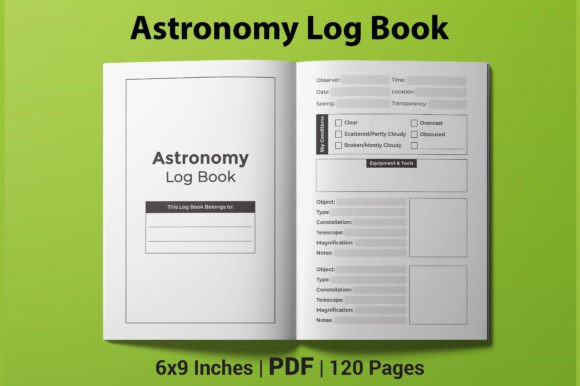
At its core, this is a ready-to-use interior file designed specifically for self-publishers on Amazon KDP or anyone who wants to print a professional-quality observation log. The template includes pre-formatted pages that guide you through recording each stargazing session. You won’t start with a blank, intimidating notebook; instead, every spread comes with thoughtful prompts: date, time, location, sky conditions, equipment used, object names, right ascension and declination, magnitude, and plenty of room for drawings or extra notes. It’s purpose-built to help you log deep-sky objects, planets, meteor showers, and even casual moon phases in a way that feels natural and organized.
Because it’s delivered as an Astronomy Log Book Interior for Amazon KDP, you skip the design work entirely. The layout respects the usual trim size, margins, and bleed settings right from the start, so your final book looks clean and consistent whether you print one copy or a hundred.
Features That Make It Print-Ready and Simple to Use
Many log book interiors fail because the technical specs are overlooked. This template removes that guesswork. Here’s what you get inside the download package:
- Dimensions: 6×9 inches – a comfortable, portable size that fits easily in a backpack or on a small desk next to a telescope.
- Page count flexibility: You receive interiors configured for 100, 110, and 120 pages. Select the version that matches your preferred book thickness and content volume.
- No bleed setup: The design uses a no-bleed interior. That means all text and graphic elements stay well within safety margins, avoiding trimming issues during printing. You won’t lose any header text or important guides along the edges.
- Multiple file formats: The download includes PDF, AI (Adobe Illustrator), EPS, and high-resolution JPG files. The PDF is already formatted and 100% ready for direct upload to Amazon KDP, while the editable source files let you tweak colors, fonts, or add a logo if you want to personalize the journal before publishing.
- High-resolution quality: All pages are optimized at a crisp resolution so that printed text remains sharp, and grid lines or subtle design accents never appear blurry.
- Interior only: The package contains the complete internal page layout. You’ll need to create your own cover—front, back, and spine—to finalize the paperback. This separation gives you creative freedom to design a cover that matches your brand, your personal taste, or the audience you’re targeting.
You won’t need any advanced design software to make this work. The provided PDF can be uploaded as is, and because it’s set to no bleed, you simply follow KDP’s straightforward print file guidelines.
Why Keeping an Astronomy Log Matters
A casual observer might wonder, “Why do I need a log book?” But the moment you start tracking your observations, the night sky reveals patterns you’d otherwise miss. Recording each session helps you:
- Monitor gradual changes: Jupiter’s cloud bands, the phases of Venus, the shifting position of a comet—these subtle shifts become obvious when you compare entries weeks apart.
- Improve your observing skills: Your notes on seeing conditions, magnification, and filter choices build a personal reference library. Over time, you’ll instinctively know which eyepiece works best for the Orion Nebula or how to handle poor transparency nights.
- Plan future sessions efficiently: Instead of guessing what to look at next, you simply flip through your log to see which objects were too faint last month or which constellations you haven’t revisited.
- Create a lasting personal archive: Your log becomes a diary of discoveries—the night you first found the Andromeda Galaxy, or the evening the Perseid meteor shower peaked. It’s far more satisfying than a digital note that might vanish in a phone crash.
The Astronomy Log Book Template gives this habit a proper framework. Rather than wrestling with the blank page, you simply fill in the fields and focus on the sky. It lowers the barrier to starting and makes every entry feel worth the effort.
Who Gets the Most from This Journal?
The great thing about a guided template is its broad appeal. You don’t need to be a professional astronomer to use it effectively. Groups that find it particularly useful include:
- Beginners who are still learning the constellations and need a friendly structure to record their first telescope views of Saturn’s rings or a lunar eclipse.
- Educators running astronomy clubs or leading night-sky field trips. Students can all use the same log format, making it easy to discuss observations in the classroom.
- Amateur astronomers tackling observing lists like the Messier or Herschel 400 catalogues. The pre-filled object fields help you methodically work through targets without missing essential data.
- Astrophotographers who want to log exposure times, ISO, camera settings, and processing notes alongside visual impressions.
- Small business owners and bloggers in the science or hobby niche. They can publish the log book under their own imprint on Amazon KDP, offering a physical product to their audience without starting from scratch.
Because the page design is simple and not overcrowded, even a ten-year-old stargazer can handle the template, yet an experienced observer will never feel it’s too basic.
Practical Ways to Use the Astronomy Log Book Template
Here are a few everyday scenarios that show how the interior fits into real life:
1. The Weekend Moon Watcher. A father and daughter take out a small refractor every Saturday. They use the 100-page version of the log. The daughter sketches the moon’s phase and notes the mare names, while the father records temperature and seeing. The template’s sketch box and moon phase checklist make it easy for a child to participate without getting lost.
2. The Messier Marathon Organizer. An amateur astronomer plans to observe all 110 Messier objects in one spring night. He prints a copy of the 120-page interior and pre-fills the object designation column for each target. During the marathon, he jots down time observed and a quick rating. Later, this becomes a detailed record he can share with his astronomy club.
3. The KDP Entrepreneur. A science blogger wants a passive income stream. She downloads the Astronomy Log Book Interior for Amazon KDP, designs a full-cover wrap featuring a telescope silhouette, and uploads the no-bleed PDF. Within a few days, she has a live listing that looks completely professional and is already formatted to KDP’s exact requirements.
4. The Astro-Imaging Workflow. An astrophotographer notes each target’s filter used, sub-exposure length, and dithering settings inside his log. Over the months, he correlates his log entries with final stacked images, improving his post-processing routine dramatically.
Things to Consider Before You Download
While the template is nearly turnkey, a few practical points will help you avoid surprises:
- Interior only means exactly that. You must create a separate cover file. If you’ve never designed a cover before, KDP’s cover creator tool can help, or you can hire a designer. Plan that time before you hit publish.
- No bleed design keeps things simple but limits full-page artwork. If you want large background images that extend to the paper edge, you’ll need a bleed-compatible template. However, for a clean, text-focused log, the no-bleed approach is easier to manage and less error-prone during print production.
- Page count variations matter. A 100-page log feels slim and lightweight, great for quick outings. A 120-page version gives you more sessions before needing a refill. Consider how frequently you observe and whether you want to bundle multiple months into one book.
- Source file formats allow editing, but not everyone needs them. The AI and EPS files are ideal if you want to adjust the interior, say to translate headers into another language or change font styles. If you’re happy with the ready-made PDF, you don’t need to touch those.
- Resolution and print readiness are tested, but always preview. After downloading, open the PDF in Amazon’s online previewer. Check that all text falls within margins and that the page count matches your selection. This is a quick sanity check that costs nothing.
None of these are dealbreakers—just small details that keep your project running smoothly.
Instant Access and a Clear Path to Publishing
Perhaps the biggest draw is how quickly you can move from idea to finished book. Once you download the files, the Astronomy Log Book Template sits ready on your computer. The PDF is pre-sized at 6×9 inches, set with no bleed, and built to KDP’s print specifications. Many users create their cover, upload both files, and have a live listing within an afternoon. The additional JPG, AI, and EPS files offer peace of mind if you ever want to rebrand the interior or adapt it for a different format.
Whether you’re crafting a personal sky journal to replace a pile of loose notes, or you’re an entrepreneur looking for an engaging low-content book to publish, this collection of interior files bridges the gap between a stargazer’s passion and a polished, physical product. It respects the nuance of astronomical observation and the practical demands of modern print-on-demand platforms—all without forcing you to become a graphic designer.