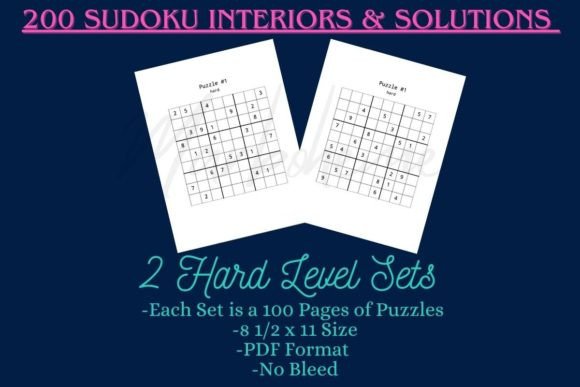
Sudoku Hard Level Interiors-200 Pages: A Practical Evaluation for Enthusiasts and Creators
For dedicated Sudoku solvers and content developers, finding the right puzzle source can be as methodical as the game itself. The Sudoku Hard Level Interiors-200 Pages product enters this space as a focused, digital-only collection of 200 challenging puzzles. It is not a physical book, an app, or a subscription service. It is a straightforward PDF package designed for printing or digital markup. This evaluation explores what the set offers, who it serves best, and where limitations may prompt a search for alternatives. The goal is to help you decide if this particular puzzle trove aligns with your objectives, whether you are an educator, a self-publisher, or simply a solver hungry for difficulty.
What the Package Actually Contains
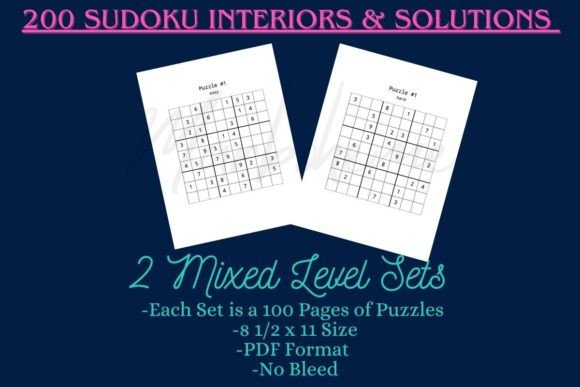
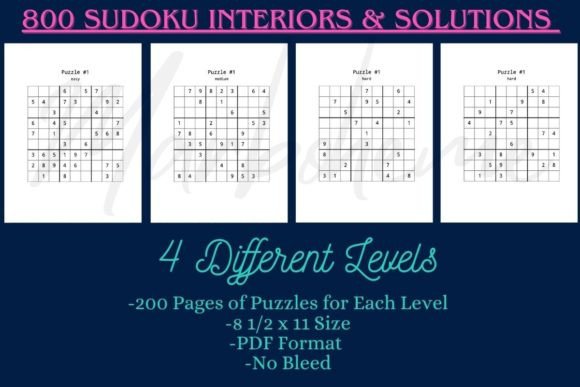
Marketed under the banner of a “Challenging Sudoku Extravaganza,” the download includes two main components: a pair of puzzle packets and their corresponding solution packets. Each puzzle packet contains 100 pages, so the full set delivers 200 pages of hard-level Sudoku. Solutions are provided in separate files, an organization choice that simplifies grading for teachers and checking for individuals. All files are standard PDFs, sized for 8.5 x 11-inch paper. There are no instructional guides, no progressive difficulty curves, and no interactive features. The product is deliberately narrow: hard puzzles, cleanly formatted, ready to be printed.
This specificity clarifies the audience. The material is not curated for casual dabblers or for those who enjoy a mix of easy, medium, and hard grids. It assumes a solver already comfortable with advanced techniques such as X-Wing, Swordfish, or simple coloring. For a newcomer to hard-level Sudoku, jumping into 200 consecutive challenging grids without an on-ramp could feel discouraging rather than rewarding.
Who Stands to Benefit Most
Three primary user groups can extract significant value from this collection, albeit for different reasons:
- Puzzle book creators and KDP publishers. If you design interiors for print-on-demand books, you need content that is legally cleared for use and already formatted. The Sudoku Hard Level Interiors-200 Pages product explicitly mentions suitability as KDP (Kindle Direct Publishing) interiors. However, a careful creator should verify the license terms regarding commercial reproduction and modifications. Assuming the license permits free commercial use, this set can save dozens of hours of puzzle generation and layout design. The consistent hard difficulty also defines a clear niche for a book’s target market.
- Teachers and educators. Hard-level Sudoku can serve as engaging brain-teasers for older students or as extension activities for gifted learners. Because the puzzle and solution files are separate, a teacher can print 100 puzzle pages for a classroom set while keeping answer keys accessible. The letter-size formatting means no trimming or scaling is necessary. Still, the uniform hardness limits its use to students who already possess solid logical reasoning skills; it would likely overwhelm a general middle-school classroom without supplementary support.
- Veteran Sudoku solvers. For someone who solves hard puzzles daily and consumes printed books quickly, this digital package offers a substantial batch of fresh grids. At 200 pages, it provides volume that surpasses many mass-market puzzle books. Because it is a one-time PDF download, there are no recurring fees, no ads, and no dependence on an internet connection after the initial download.
Key Benefits and Practical Trade-offs
Evaluating any puzzle resource requires balancing its strengths against inherent limitations. The following points highlight where this product delivers and where it may fall short depending on your needs.
Advantages to Consider
- Print flexibility. Standard letter-size PDF means instant compatibility with home or office printers. You can print a single puzzle, a whole packet, or double-sided sheets. This is a significant advantage over mobile apps that keep you tethered to a screen.
- Logical organization. The division into two 100-page packets, each with its own solution file, helps manage large print jobs and keeps puzzle-answer relationships clear. This structure is especially useful for creating book interiors or classroom packets.
- Digital permanence. Unlike a subscription site where access ends if you cancel, purchased PDFs remain in your possession. You can reuse the puzzles indefinitely for personal or permitted commercial use.
- No learning curve for the product itself. There is no software to learn, no logins, and no platform dependency beyond a PDF reader.
Trade-offs That May Influence Your Decision
- Uniformly hard difficulty. While the title accurately advertises “hard level,” there is no internal progression. A solver who prefers to warm up with moderate puzzles or who wants a balanced challenge may find the lack of variety monotonous or overly taxing. If you are creating a puzzle book for a wide audience, you might need to combine this content with easier material from other sources.
- No interactive solving experience. Solving on paper requires erasing or using pencil, and there is no automated error-checking or hint system. For some, this tactile approach is precisely the point. For others, the immediacy of tap-to-fill apps and the feedback of auto-candidates may be more compatible with their solving style.
- Absence of puzzle-generation methodology transparency. The product description does not detail whether puzzles guarantee a unique solution, what difficulty algorithm was used, or whether they were tested for logical solvability without guessing. Reputable collections usually meet these standards, but a buyer who is particularly rigorous may wish to verify before committing to a purchase, especially if the puzzles will be published commercially.
- Printing costs and physical storage. Two hundred pages of Sudoku, even when printed frugally, consume ink and paper. For solvers who rely on tablets and styluses, PDFs are a fine match. Those who prefer paper but want to avoid printing 200 sheets might find a pre-printed book more economical.
Comparing the Collection to Common Alternatives
Placing this product alongside other options clarifies its role. Evaluate it not in isolation but relative to what else is available for your use case.
Printed Sudoku books. A large-print or hard-level book from a major publisher typically costs between $8 and $15 and offers 200–400 puzzles. Those books often include spiral binding, varying difficulty levels, or instruction sections. However, printed books are single-use, cannot be legally reproduced, and may not suit a KDP interior designer who needs editable or repurposable source files. The Sudoku Hard Level Interiors-200 Pages product trades physical convenience for digital flexibility and, provided the license permits, commercial reusability.
Sudoku mobile applications. Apps like Sudoku.com, Andoku, or Enjoy Sudoku provide thousands of puzzles at several difficulty tiers, along with pencil marks, hints, and error highlighting. Many are free with ads or require a small one-time purchase. They are unbeatable for pure solving convenience and portability. The PDF collection cannot compete on interactive features, but it eliminates screen fatigue, subverts algorithmic suggestions, and creates a distraction-free environment. For an educator or publisher, apps are not a content source.
Free printable Sudoku websites. Numerous sites offer free printable hard Sudoku puzzles. The challenge is consistency: puzzles may vary in formatting, solution availability, or true difficulty level. The Sudoku Hard Level Interiors-200 Pages download replaces that ad-hoc searching with a pre-formatted, uniform set. For occasional solving, free sites are sufficient. For a teacher who needs 100 clean, identical-looking sheets on short notice, the paid package may be worth the time savings.
Bespoke puzzle generation software. Tools like Sudoku Generator (for Windows) or online APIs allow you to create your own puzzles with precise specifications. This route offers maximum control over difficulty gradation, grid layout, and even the number of given digits. It often demands a learning investment and may require a commercial license. If you need a tailored, evolving product, a generator is superior. If you simply need a ready-made, hard-level batch, the Sudoku Hard Level Interiors-200 Pages set is a convenient off-the-shelf alternative.
Considerations for Commercial and Classroom Reuse
Because the product explicitly targets KDP interiors and teacher printables, usage rights demand scrutiny. The marketing language encourages these applications, but the exact license details should be confirmed. As a potential buyer, you would want to know:
- Can puzzles be used inside a book sold for profit, or is the license limited to personal and classroom use?
- Are there attribution requirements?
- Can the pages be modified, such as adding a header or changing the numbering style?
If the license is permissive, the value proposition rises sharply for content creators. If it is restrictive, the product may still serve personal and educational use, but its utility for publishers evaporates. A careful evaluation before purchase, perhaps by contacting the seller, is prudent.
For teachers, the separate solution packets are a thoughtful touch. However, consider whether the difficulty truly suits your student population. Hard-level Sudoku can frustrate learners who lack foundational strategies. In a mixed-ability classroom, you might need to supplement with medium-level puzzles or provide mini-lessons on advanced solving techniques. The product itself offers no such pedagogical scaffolding.
How to Determine If This Product Matches Your Goals
Given the range of options, the decision to acquire the Sudoku Hard Level Interiors-200 Pages set reduces to a few clarifying questions. Answer them honestly, and the path becomes clearer.
- Do you need hard puzzles specifically, and in substantial quantity? If yes, this set directly meets that need. If you want a mix, multiple difficulty levels from other sources will serve you better.
- Is a PDF the right format for your workflow? For printing, binding, or tablet stylus solving, PDF is ideal. If you solve primarily on a phone during commutes, an app’s interface will be far more satisfying.
- Are you a teacher or publisher who benefits from separate solution files and legal reproducibility? The organizational design suggests the creators had these audiences in mind. If you are one of them, the product’s structure aligns neatly with your likely needs.
- What is your tolerance for upfront printing effort? If you are happy to print batches or keep the files on a tablet indefinitely, the digital nature is an asset. If you dislike managing printouts, a pre-printed book may save daily friction.
- Can you verify the license terms for your intended use? The product’s marketing is suggestive, but your own due diligence is the only safeguard. A mismatch here could limit the product’s value significantly.
Realistic Expectations for Solvers
If you are a seasoned solver, expect to encounter puzzles that often require full candidate notation and a systematic approach. Some may contain patterns that demand focused attention for 20 to 40 minutes each. The satisfaction of cracking a tough grid remains, but the absence of a built-in timer or performance tracking (features common in apps) means you will need to self-monitor progress if that matters to you. For many paper-solving purists, this is not a drawback; it is a return to a quieter, more deliberate experience.
On the technical side, the PDF should open and print correctly on any modern device. Still, if you plan to use a tablet, you may want a note-taking app that allows easy page navigation and erasing. The files themselves have no interactivity, no fillable forms, and no embedded scripts. This simplicity guarantees broad compatibility but also places the onus of the solving environment entirely on the user.
In summary, the Sudoku Hard Level Interiors-200 Pages is a no-frills, high-volume resource tailored to a specific audience. It does not pretend to be a comprehensive learning system or a versatile puzzle collection. For those whose needs align—hard puzzle enthusiasts, resourceful educators, and KDP interior creators—it offers a straightforward, immediately usable asset. For others, evaluating the trade-offs in difficulty uniformity, format, and interactivity will likely steer them toward complementary or alternative solutions. The key is not whether it is universally excellent, but whether it fits the niche you need to fill.